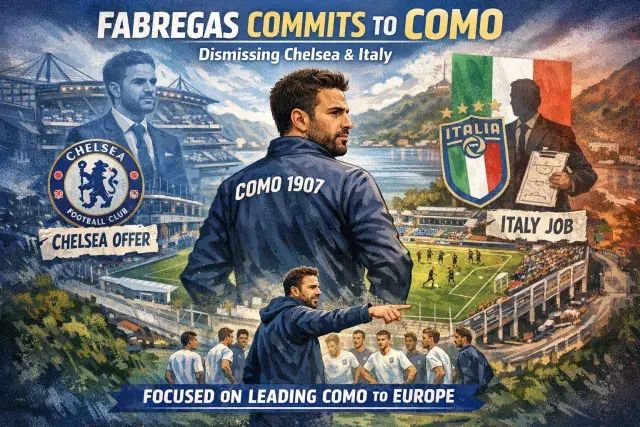
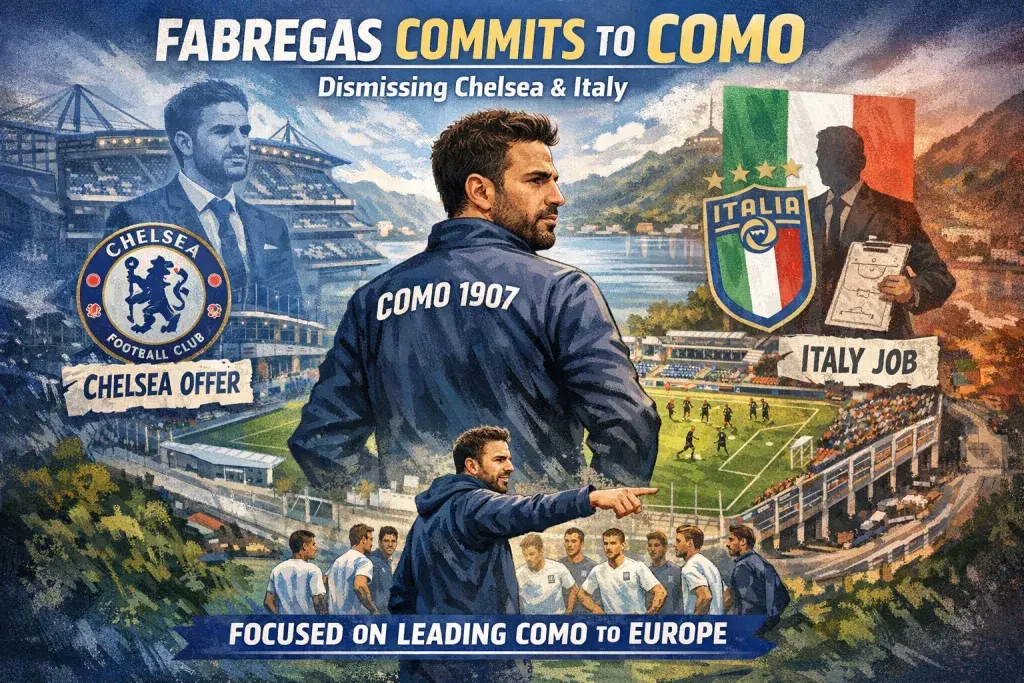
Cesc Fabregas has made clear that he intends to honour his contract at Como, which runs until 2028, brushing aside persistent speculation linking him to a return to Chelsea and a potential role with the Italian national side. The 38-year-old Spaniard, speaking after receiving the Enzo Bearzot award — one of Italian football management's most distinguished honours — cited his family's wellbeing and his need for daily hands-on involvement as the decisive factors in his thinking. His remarks arrive at a pivotal moment: Como currently sit fifth in Serie A with six fixtures remaining, placing the Lombardy club within genuine reach of European qualification for the first time in its history.
A Manager Who Has Outpaced Expectations
When Fabregas was appointed at Como in early 2023, the club had only recently returned to the Italian top flight after a lengthy absence. The expectation was consolidation. What followed instead was a rapid transformation in identity, style, and ambition. Fabregas, who spent his playing career at Arsenal, Barcelona, and Chelsea among others, arrived with a clear footballing philosophy shaped by elite environments, and he has embedded it systematically at the Stadio Giuseppe Sinigaglia.
The result is a club that has moved far beyond the survival conversation. Fifth place in Serie A is not an accident of circumstance — it reflects a coherent approach to recruitment, development, and tactical identity built over two years. Como's ownership group, led by Indonesian president Mirwan Suwarso, has provided the financial backing, but industry observers have consistently pointed to Fabregas as the intellectual engine of the project.
That success has inevitably attracted attention. Chelsea, the club where Fabregas spent his final playing years and with which he retains deep ties, have been linked with him as a managerial candidate. The Italian Football Federation is also understood to be monitoring candidates following the tenure of Luciano Spalletti, and Fabregas — a figure with credibility across both Italian and Spanish football cultures — represents a compelling option. His refusal to engage with either prospect, at least for now, carries weight precisely because the opportunities are genuine.
Family, Proximity, and the Logic of Staying
Fabregas has been unusually candid about the personal calculus behind his decision. "My family is happy in Como," he said plainly, and he has described that condition as non-negotiable. This is not a minor detail. Managerial careers at the highest level demand relentless mobility — city to city, country to country — and the personal toll on families is well documented across the profession. Fabregas appears to have drawn a clear line: professional advancement does not automatically override domestic stability.
There is also a philosophical dimension to his reasoning. He has described himself as a manager who needs to be on the training pitch every day, who requires the texture and immediacy of daily work to feel engaged. The role of a national side manager is structurally incompatible with that temperament. Squads assemble during international windows and then disperse; weeks pass without contact; preparation is compressed. For a manager who thrives on continuity and daily relationships with his group, that model holds little appeal at this stage of his career. "Maybe in the future, when I'm older," he acknowledged — a measured concession, not an open invitation.
What the Club Understands About Its Own Situation
Suwarso's comments to Rivista Undici in mid-March were striking for their honesty. The Como president openly acknowledged that Fabregas will likely move on one day — naming Arsenal, Barcelona, and Chelsea as probable destinations — and suggested the club should involve him in identifying his own successor. This is a significant admission from an ownership group that has invested heavily in building around a single managerial identity.
It also reflects a mature understanding of how elite managerial development works. The clubs that produce great managers rarely retain them indefinitely. What they can do is ensure the values and structures outlast the individual. Suwarso's framing suggests Como's hierarchy is already thinking in those terms — planning not for Fabregas to stay forever, but for what he leaves behind to endure.
For the moment, however, none of that is imminent. A Coppa Italia semi-final second leg against Inter Milan awaits at the San Siro on April 21, with the aggregate score level at 0-0. Before that, a demanding Serie A fixture at Sassuolo demands full attention. Fabregas has two fronts on which Como could yet make history, and every indication is that he intends to be present for both.